Introduction
If you’ve been shopping around this summer, you’ve probably noticed one thing quickly: the inverter AC price in Pakistan varies a lot more than it used to. Between rupee fluctuations, changing import duties, and a flood of new inverter models from local and international brands, working out what you should actually pay for a good unit has become confusing.
I’ve spent years working with air conditioners and appliances in the Pakistani market, and the question I get asked most often isn’t “which AC is best” — it’s “am I paying a fair price for this?” This guide answers that directly. We’ll walk through current price ranges by capacity and brand, explain what actually drives the cost of an inverter AC, and help you figure out exactly what you need for your room, your budget, and your electricity bill.
Quick Answer
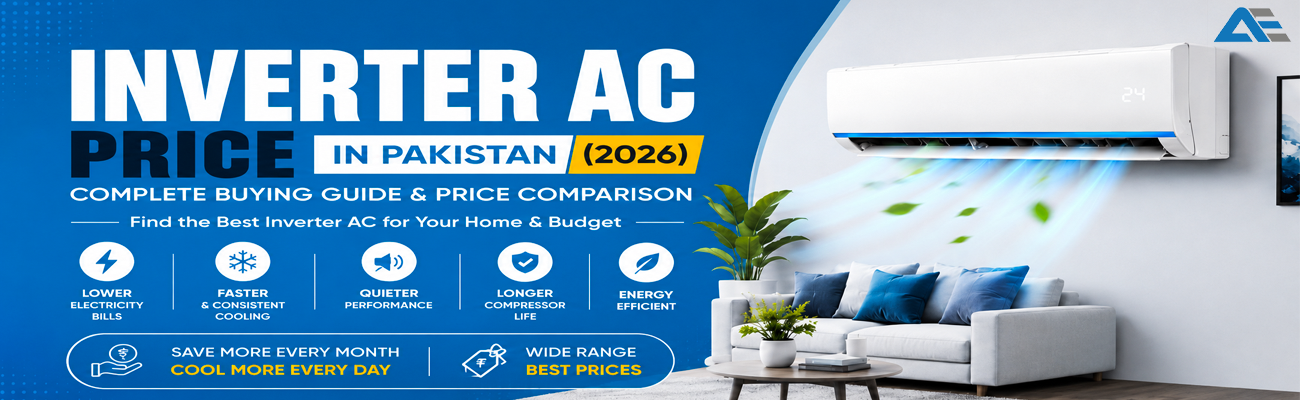
An inverter AC in Pakistan typically costs more upfront than a non-inverter unit but pays that difference back through lower electricity bills over one to two cooling seasons. As of mid-2026, a 1 Ton inverter AC generally falls in the range of PKR 110,000–160,000, a 1.5 Ton unit in the range of PKR 140,000–210,000, and a 2 Ton unit in the range of PKR 190,000–280,000, depending on brand, features, and ongoing promotions. Prices shift with currency movement and seasonal demand, so always confirm the current price with your retailer before buying.
Latest Prices in Pakistan
Prices below are indicative ranges compiled from typical retail listings. They change frequently due to exchange rate movement, import costs, and seasonal promotions, so treat this as a starting point for comparison rather than a fixed quote.
| Brand | Capacity | Technology | Key Features | Price Range (PKR) |
| Dawlance | 1 Ton | Inverter | Turbo cooling, low-voltage start, Wi-Fi option | 115,000 – 150,000 |
| Dawlance | 1.5 Ton | Inverter | Dual-zone cooling, quiet mode | 150,000 – 195,000 |
| Haier | 1 Ton | Inverter | Self-clean, energy-saving mode | 120,000 – 155,000 |
| Haier | 1.5 Ton | Inverter | Triple inverter tech, Wi-Fi control | 155,000 – 205,000 |
| Gree | 1 Ton | Inverter | 4D swing airflow, anti-corrosion coating | 115,000 – 148,000 |
| Gree | 1.5 Ton | Inverter | Cold plasma filtration | 150,000 – 200,000 |
| Orient | 1 Ton | Inverter | Turbo mode, sleep mode | 105,000 – 140,000 |
| Orient | 1.5 Ton | Inverter | Smart diagnosis | 140,000 – 180,000 |
| PEL | 1.5 Ton | Inverter | Gold fin condenser, low noise | 145,000 – 190,000 |
| Various brands | 2 Ton | Inverter | Suitable for large rooms/halls | 190,000 – 280,000 |
| Various brands | 1.5 Ton | Non-Inverter | Fixed-speed compressor, lower upfront cost | 95,000 – 130,000 |
For a full, regularly updated breakdown, check the AC price in Pakistan or inverter AC price in Pakistan listings on our site before finalizing your purchase, since prices update as new stock arrives.
Best Options Available
Rather than chasing the single “best” AC, it helps to think in terms of use case:
- Best for small bedrooms (up to 120 sq ft): A 1 Ton inverter unit from Dawlance or Orient balances upfront cost with running efficiency.
- Best for average Pakistani living rooms (120–180 sq ft): 1.5 Ton inverter units from Haier or Gree are the most commonly recommended size, with the widest selection.
- Best for lounges, halls, or south-facing rooms with heavy heat load: 2 Ton inverter units handle Pakistan’s peak summer temperatures without straining.
- Best for tight budgets: A non-inverter 1.5 Ton unit costs less upfront, though it will usually cost more over 3–4 years in electricity.
You can browse a curated shortlist on our Best Inverter AC in Pakistan page, or compare capacity-specific pages like 1 Ton AC Price in Pakistan and 2 Ton AC Price in Pakistan if you already know your room size.
Features to Consider Before Buying
Before comparing brands, it’s worth understanding what actually affects both price and performance:
- Compressor type: Rotary inverter compressors are now standard in mid-range and premium units; they modulate speed instead of switching fully on/off.
- Cooling capacity vs. room size: Oversized units cool faster but cycle inefficiently in small rooms; undersized units struggle in Pakistan’s peak heat.
- Energy Efficiency Ratio (EER) / star rating: Higher-rated units cost more initially but save more on electricity.
- Low-voltage startup: Useful given Pakistan’s voltage fluctuations, especially in areas with unstable grid supply.
- Refrigerant type: Newer R32 refrigerant units are more environmentally friendly and increasingly common.
- Noise levels: Indoor unit noise matters more in bedrooms; check decibel ratings if you’re a light sleeper.
- Warranty terms: Compressor warranties (5–10 years) matter more than general warranty length, since the compressor is the most expensive part to replace.
- After-sales service network: A brand with wide service coverage in your city saves you headaches later, particularly outside major cities.
Inverter AC vs Non-Inverter AC
| Aspect | Inverter AC | Non-Inverter AC |
| Compressor | Variable speed | Fixed speed (on/off cycling) |
| Electricity usage | Lower, especially on continuous use | Higher, due to repeated restarts |
| Upfront price | Higher | Lower |
| Cooling consistency | Smoother, fewer temperature swings | Fluctuates as compressor cycles |
| Noise | Generally quieter | Louder on startup |
| Compressor lifespan | Often longer with proper maintenance | Shorter due to constant cycling |
| Best for | Daily, extended use | Occasional or short-duration use |
Electricity Consumption and Savings
This is where inverter technology earns its higher price tag. A non-inverter 1.5 Ton AC running for 8 hours a day can consume noticeably more units of electricity per month than an inverter model of the same capacity, because the compressor is constantly switching fully off and on rather than adjusting its speed to match the room’s actual cooling need.
In practical terms, many households report a 30–45% drop in AC-related electricity consumption after switching from a non-inverter to an inverter unit of similar capacity — though actual savings depend on usage hours, room insulation, outdoor temperature, and thermostat settings. With Pakistan’s current per-unit electricity tariffs, this difference can add up to tens of thousands of rupees over a single cooling season for a household running one or two ACs regularly.
Best AC Brands in Pakistan
- Dawlance: Strong local manufacturing base, wide service network, competitive pricing on mid-range inverter units.
- Haier: Known for advanced inverter technology and smart/Wi-Fi-enabled features, slightly higher price point.
- Gree: Popular for durability and airflow technology, with a solid mid-to-premium lineup.
- Orient: Generally the most budget-friendly of the major brands, good entry point for first-time inverter buyers.
- PEL: Established local brand with dependable after-sales support across most cities.
No single brand is universally “best” — the right choice depends on your budget, room size, and how much weight you put on smart features versus straightforward reliability.
Which AC Capacity Should You Buy?
| Capacity | Recommended Room Size | Typical Use Case |
| 1 Ton AC | Up to 120 sq ft | Small bedrooms, single-occupant rooms |
| 1.5 Ton AC | 120–180 sq ft | Standard bedrooms, small living rooms |
| 2 Ton AC | 180–250 sq ft | Large living rooms, halls, south-facing rooms |
1 Ton AC: The most affordable inverter option, ideal for smaller enclosed spaces. Undersized for larger rooms, where it will run constantly without reaching the set temperature efficiently.
1.5 Ton AC: The most commonly sold capacity in Pakistan, suited to the average bedroom or small lounge. It’s the size most brands optimize their inverter technology around, so you’ll find the widest model selection here.
2 Ton AC: Necessary for larger rooms or spaces with high heat load (large windows, direct sun exposure, high ceilings). Costs more upfront and consumes more electricity, but is far more efficient than undersizing a smaller unit for a big room.
Buying Guide for Pakistani Consumers
- Measure your room first. Capacity mismatches are the single biggest cause of buyer regret.
- Set a realistic budget range, including installation costs, which are sometimes separate from the unit price.
- Compare at least three brands at your target capacity before deciding — price differences of PKR 10,000–20,000 for similar specs are common.
- Check current promotions. Retailers frequently run seasonal discounts, bank installment plans, and bundle deals, particularly just before and during peak summer.
- Confirm warranty terms in writing, especially the compressor warranty period.
- Ask about installation and delivery. In most cities, professional installation should be included or clearly priced separately.
- Verify service availability in your city before buying a brand with a thin service network outside major urban centers.
- Avoid buying purely on lowest price. A unit priced well below the market range for its capacity and brand is worth double-checking for genuine warranty coverage.
Frequently Asked Questions
What is an inverter AC?
An inverter AC uses a variable-speed compressor that adjusts its output to match the room’s actual cooling demand, rather than switching fully on and off like a conventional unit.
Which AC is best in Pakistan?
There’s no single best AC — Dawlance, Haier, Gree, Orient, and PEL all offer strong inverter options at different price points, so the right pick depends on your room size and budget.
What is the price of inverter AC in Pakistan?
As of mid-2026, inverter AC prices typically range from around PKR 110,000 for a 1 Ton unit to PKR 280,000 for a 2 Ton unit, depending on brand and features.
Which AC consumes less electricity?
Inverter ACs generally consume less electricity than non-inverter units, especially when run for extended hours, because they modulate compressor speed instead of cycling on and off.
Is inverter AC worth buying?
For most households running their AC daily during summer, yes — the higher upfront cost is usually recovered through electricity savings within one to two cooling seasons.
What size AC do I need?
As a general guide, a 1 Ton AC suits rooms up to 120 sq ft, a 1.5 Ton AC suits 120–180 sq ft, and a 2 Ton AC suits 180–250 sq ft, though heat load and sun exposure can shift these numbers.
What is the price of 1 ton AC in Pakistan?
A 1 Ton inverter AC typically costs between PKR 110,000 and 160,000, depending on brand and features.
What is the price of 2 ton AC in Pakistan?
A 2 Ton inverter AC generally costs between PKR 190,000 and 280,000, depending on brand and specifications.
Which AC brand is most reliable?
Dawlance, Haier, Gree, and PEL all have long-standing reputations for reliability in Pakistan, with wide service networks that make repairs and maintenance easier.
How much electricity does an inverter AC use?
Electricity use depends on capacity, room insulation, and usage hours, but inverter units typically use 30–45% less electricity than a comparable non-inverter unit over similar usage patterns.
Which AC is best for Karachi weather?
Given Karachi’s humid heat, a well-sized inverter AC with strong dehumidification and turbo cooling features tends to perform better than a standard fixed-speed unit.
Is DC inverter AC better than conventional AC?
DC inverter ACs are generally more energy-efficient and provide more consistent cooling than conventional (non-inverter) units, though they cost more upfront.
How long does an inverter AC last?
With proper maintenance, an inverter AC compressor can last 10 years or more, though actual lifespan depends on usage patterns and voltage stability.
What is the difference between split AC and inverter AC?
“Split AC” refers to the physical design (separate indoor and outdoor units), while “inverter” refers to the compressor technology — most modern split ACs in Pakistan now come with inverter compressors, but the two terms aren’t interchangeable.
Which AC has the lowest running cost?
Inverter ACs with high EER ratings and appropriately sized for the room generally have the lowest running cost over time, even though their purchase price is higher.
Conclusion
Working out the right inverter AC price in Pakistan for your needs comes down to three things: getting the capacity right for your room, comparing a few trusted brands at that capacity, and factoring in electricity savings rather than just the sticker price. Prices do shift with currency movement, import costs, and seasonal promotions, so it’s worth checking current listings and confirming with your retailer before you commit, rather than relying on last season’s numbers.
Whichever brand or capacity you land on, compare a few models side by side, check the warranty terms in writing, and ask about delivery and installation upfront — that’s usually where buyers get caught out, not the sticker price itself.